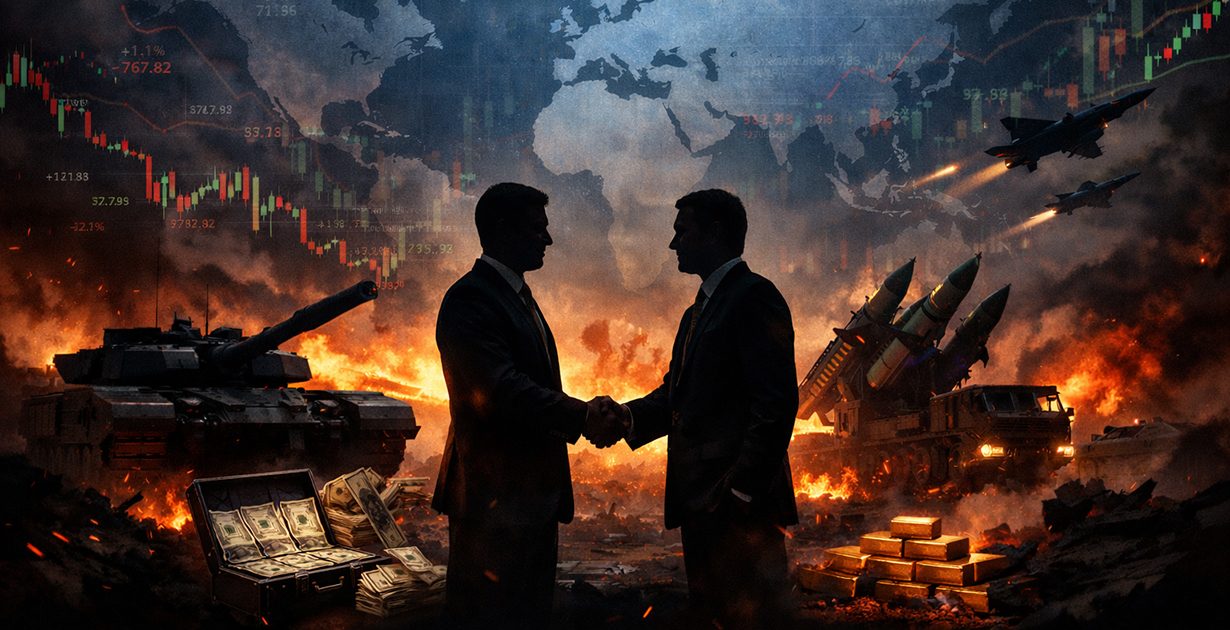
War trade investing is the practice of positioning portfolios around geopolitical conflict. When nations go to war, commodity prices spike, defense stocks rally, and entire sectors rotate in predictable patterns. Understanding the war trade gives investors a framework to navigate — and profit from — the market impact of military escalation.
History says to buy the war.
History says markets rally once the first missiles fly.
History says defense stocks outperform.
History says volatility is opportunity.
History also says certainty is comforting.
The consensus view has calcified into a reflex: geopolitical shock, initial dip, policy response, fiscal stimulus, rally. Rinse. Repeat. A generation of investors has internalized the pattern.
What follows is not a prediction. It is a reconstruction of the narrative investors tell themselves about wartime markets — and an examination of what that narrative quietly assumes.
The Myth of Wartime Bullishness
Across major U.S. conflicts, the data looks deceptively clean.
During World War II, U.S. equities rose approximately 17% over the duration of the war. During the Korean War, stocks climbed roughly 19%. In more recent conflicts, markets have frequently dipped on headlines and then recovered within weeks or months.
Prewar jitters tend to depress prices.
The first shots trigger panic.
Mobilization restores order.
Fiscal stimulus accelerates growth.
Stocks move higher.
The pattern appears almost mechanical.
The S&P 500 fell in the months leading into World War II, only to rebound strongly once the U.S. formally entered the conflict. Following the invasion of Iraq in March 2003, the Dow Jones Industrial Average rose more than 8% in the subsequent month. After the initial shock of the Russian invasion of Ukraine in February 2022, U.S. markets stabilized quickly despite sharp declines in Europe.
The conclusion most investors draw is simple: war is volatility, not destruction. Buy the dip.
But that conclusion rests on a fragile premise — that the war is finite, geographically contained, and fiscally stimulative.
The First Move Is Almost Always Down
The historical record is consistent on one point: markets do not celebrate the outbreak of conflict.
The day after Pearl Harbor, the Dow Jones Industrial Average fell 3.5%.
When the Korean War began, it dropped 5%.
After September 11, markets reopened down 7.1%.
Uncertainty is toxic to valuations. Investors reprice risk immediately.
Yet something interesting happens next.
Once the uncertainty shifts from “Will there be war?” to “We are at war,” the market begins recalibrating. Risk is no longer abstract. It is quantifiable. Fiscal policy becomes expansionary. Defense budgets rise. Industrial capacity mobilizes.
The fog lifts just enough for capital to flow again.
Markets prefer bad certainty to good ambiguity.
Defense Outperformance and the Illusion of Safety
Defense stocks consistently outperform during periods of heightened geopolitical risk. Studies covering 1937 through 2017 show that military spending reduces volatility for defense contractors and related industries — steel, coal, textiles, food.
Revenue visibility improves.
Government contracts stabilize cash flow.
Earnings forecasts tighten.
In the modern era, analysis of defense companies from 1990 to 2018 shows stock prices often rise following announcements of direct U.S. involvement in conflict. Gains, however, tend to be front-loaded and short-lived.
This creates a reinforcing loop in investor psychology:
- War breaks out.
- Defense stocks rally.
- The broader market stabilizes.
- The narrative of resilience strengthens.
Over time, war becomes framed less as a systemic threat and more as a sector rotation.
The Fiscal Stimulus Argument
The deeper bullish thesis rests on macroeconomics.
Wars historically coincide with increased government spending.
Increased spending supports GDP.
Higher GDP supports corporate earnings.
Higher earnings support equity prices.
World War II was the ultimate example of fiscal mobilization. Industrial output surged. Employment rose. Manufacturing capacity expanded. Nominal GDP exploded higher.
From an accounting perspective, war can look like growth.
But growth driven by mobilization is not the same as growth driven by productivity or innovation. It is demand pulled forward under extraordinary circumstances. The state becomes the marginal buyer.
Markets price earnings. They do not price social cost.
Surprise vs. Contained Conflict
Not all wars are equal.
Surprise attacks — Pearl Harbor, the Korean War’s outbreak — triggered immediate and sharper selloffs. Anticipated conflicts, where diplomatic tension escalates for months, often see weakness ahead of the event and relief afterward.
The invasion of Iraq in 2003 illustrates the latter dynamic. Markets had been falling amid uncertainty. Once military action began, clarity replaced speculation, and equities rallied.
The common thread is not war itself. It is the resolution of uncertainty.
Investors do not demand peace. They demand predictability.
The One-Year Rebound Thesis
A review of more than 50 major geopolitical events since the 1950s suggests that U.S. stocks tend to decline in the immediate aftermath — often around 10% — and then recover within a year, delivering average gains near 11% twelve months later.
The pattern appears robust.
But averages conceal distribution.
Short conflicts differ from protracted ones.
Regional wars differ from global ones.
Limited engagement differs from structural regime change.
The postwar rebounds investors cite often occurred in environments where the U.S. mainland was economically insulated and fiscal capacity was unconstrained.
Those conditions are not constants. They are variables.
Bonds, Inflation, and the Hidden Costs
While equities often recover, bonds and credit markets tell a more complicated story. Inflation outcomes vary significantly by conflict.
World War II brought price controls and rationing alongside fiscal expansion. The 1970s oil shocks tied to geopolitical instability fueled stagflation. Modern conflicts influence energy prices, supply chains, and commodity markets in ways that ripple beyond defense spending.
Equities may rally even as real purchasing power erodes.
Nominal returns can mask real deterioration.
The Behavioral Feedback Loop
The more often investors observe markets recovering from geopolitical shocks, the stronger the reflex becomes.
Dip-buying turns into doctrine.
Volatility becomes an entry point.
Risk premiums compress faster each cycle.
Confidence builds not because risk has diminished, but because past outcomes have reinforced optimism.
The danger is not that markets have historically rallied during wartime.
The danger is assuming they always will.
What the Data Actually Says
The data does not say war is bullish.
It says:
- Markets typically fall at the onset of conflict.
- They often recover once uncertainty stabilizes.
- Defense and related industries tend to outperform during heightened military spending.
- Long-term investors who avoided panic selling were generally rewarded.
It does not guarantee short-lived weakness.
It does not guarantee contained escalation.
It does not guarantee fiscal dominance without consequence.
It describes patterns within specific historical constraints.
The Real Variable: Economic Structure
In past conflicts, the U.S. economy retained structural advantages:
- Domestic energy production.
- Industrial self-sufficiency.
- Reserve currency dominance.
- Manageable federal debt-to-GDP ratios relative to wartime needs.
Markets rallied not simply because war began, but because the economic machine remained intact and capable of absorbing the shock.
A conflict that disrupts supply chains, destabilizes currency markets, or fractures trade alliances presents a different equation.
Markets price survivability. Not heroism.
The Takeaway
War does not automatically crash markets. Nor does it inherently boost them.
Initial declines are common.
Rebounds are frequent.
Long-term investors have often benefited from discipline over emotion.
But the narrative that “war is bullish” is an oversimplification born from selective observation.
Stocks rise when earnings survive.
Earnings survive when the economic engine endures.
The economic engine endures when structural foundations remain intact.
History shows resilience. It does not promise immunity.
The next conflict will not look exactly like the last six. It never does.
The question is not whether markets have rallied before.
The question is what assumptions are embedded in portfolios today — and whether those assumptions survive the next test.
The data says volatility is temporary.
It does not say risk is.
How to Apply War Trade Investing on Traderverse
War trade investing requires staying ahead of fast-moving geopolitical developments. The traders who profit most are those who understand the historical playbook — energy goes up, safe havens attract capital, and defense contractors outperform. By studying past conflicts, you can build a war trade investing framework that works across different scenarios.
See how the current geopolitical landscape is affecting energy markets in our analysis of the 60-day rule and oil prices, and read our deep dive into Venezuela’s oil reserves and global energy markets.
For real-time geopolitical risk analysis, see the Council on Foreign Relations Global Conflict Tracker and defense sector data from SIPRI.
Follow war trade investing strategies and real-time analysis from top traders on Traderverse.
Leave a Reply